
Everybody wants to be the next Warren Buffett. You open a brokerage account, join a Facebook trading group, and suddenly you’re convinced you can spot the next big breakout stock. You buy the dip. You read technical analysis charts that look like Jackson Pollock paintings.
Here is the cold, brutal truth: You are probably losing money. If not in absolute terms, then definitely when adjusting for time, fees, and opportunity cost.
Stock picking is a game rigged against retail investors. Let’s look at the mathematical reality of active trading versus passive index fund investing.
The Illusion of "Beating the Market"
Active fund managers are professionals who get paid millions to analyze financial statements 80 hours a week. They have access to Bloomberg terminals, proprietary algorithms, and insider networks.
Do you know their success rate?
Over a 15-year period, more than 90% of actively managed equity funds fail to beat their benchmark index (like the S&P 500). Read that again. Nine out of ten professionals fail to beat a basic, brainless index fund.
If the guys with PhDs in finance can't consistently pick winning stocks over a long horizon, what makes you think you can do it by reading a Reddit thread on your lunch break?
The Hidden Drain: The Math of Trading Fees
Let’s run a scenario. Let's look at the silent killer of wealth: transaction costs and taxes.
Meet Juan. Juan is an active trader on the Philippine Stock Exchange (PSE). He actively buys and sells stocks, trying to capture 5% gains here and there. He starts with a ₱100,000 portfolio and makes two trades a month.
In the Philippines, every time you sell a stock, you get hit with a slew of fees:
- Stock Transaction Tax: 0.6% of the gross selling amount.
- Broker's Commission: 0.25% (usually).
- VAT on Commission: 12% of the commission.
- Clearing Fee & SCCP: 0.01%.
Let's simplify. You pay roughly 1.19% in total fees for a round-trip (buy and sell) trade.
If Juan trades his entire ₱100,000 portfolio twice a month, he is paying around ₱2,380 in fees monthly. That’s ₱28,560 a year.
Juan is losing 28.5% of his portfolio value annually just to trading fees.
Juan has to generate a 28.5% return on his investments just to break even. Anything less, and his net worth is shrinking. This doesn't even factor in inflation.
Day traders attempt to outsmart the market. Index fund investors simply buy the market and wait. The statistics are overwhelmingly clear: trying to time the market is a fool's errand. Time in the market is what truly builds wealth.
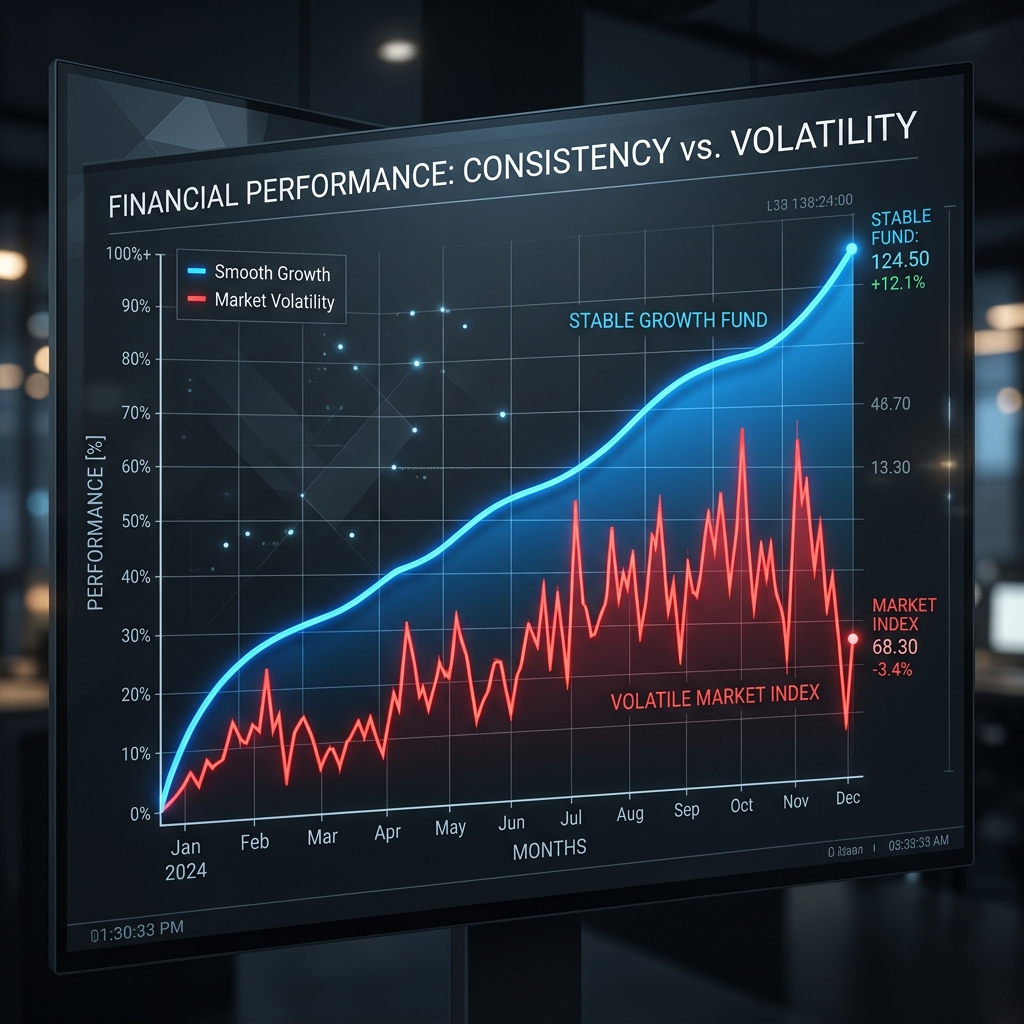
Now meet Maria. Maria takes her ₱100,000 and dumps it into the First Metro Philippine Equity Exchange Traded Fund (FMETF). FMETF tracks the top 30 companies in the Philippines. She pays a one-time buying fee of roughly 0.29%. Then, she does absolutely nothing. She goes to the beach.
The fund has a management fee of 0.5% per annum. Maria pays ₱500 a year for the fund to automatically rebalance and track the market.
Juan is playing a high-stress video game where he loses 28.5% automatically. Maria is playing a low-stress game where she loses 0.5%. Who wins over a 20-year horizon? The math isn't even close.
The Opportunity Cost of Time
Let’s talk about your hourly rate.
Assume Juan manages to overcome the insane fee structure. Let’s pretend he beats the market by 2% annually. On a ₱100,000 portfolio, that’s an extra ₱2,000 a year.
How much time did Juan spend achieving that? Let's say he spends 5 hours a week reading earnings reports, watching business news, and staring at stock charts. That is 260 hours a year.
Juan earned an extra ₱2,000 for 260 hours of work. Juan’s effective hourly rate is ₱7.69.
He would literally make more money flipping burgers at a fast-food joint. The opportunity cost is staggering. He could have spent those 260 hours learning a high-income skill, doing freelance work, or simply sleeping.
The Mechanics of Index Funds
An index fund is just a basket of stocks that mirrors a specific market index. When you buy a share of an S&P 500 index fund, you instantly own a microscopic sliver of the 500 largest publicly traded companies in the United States—Apple, Microsoft, Amazon, etc.
Here is why this strategy is mathematically superior for 99% of people:
- Instant Diversification: If you pick five stocks and two go bankrupt, you lose 40% of your net worth. If two companies in the S&P 500 go bankrupt, they drop out of the index and are replaced by the next largest companies. You barely notice.
- Self-Cleansing Mechanism: Indexes are inherently Darwinian. Losers are automatically booted out. Winners naturally take up a larger percentage of the fund. You are mathematically guaranteed to always own the biggest, most successful companies in the economy.
- Near-Zero Friction: Low expense ratios mean your money actually compounds for you, not for your broker.
Step-by-Step: Stop Picking, Start Indexing
You want to optimize your portfolio today? Stop playing the lotto. Do this instead.
- Open a Global Brokerage: The Philippine market has been sluggish for years. Get exposure to global markets. Download GoTrade or Interactive Brokers. They allow Filipinos to easily invest in US ETFs.
- Pick a Broad Market ETF: Look for Vanguard S&P 500 ETF (VOO) or Vanguard Total Stock Market ETF (VTI). These have expense ratios of around 0.03%. That is practically free.
- Automate the Purchase: Set a specific amount you can afford to invest every payday—say, ₱5,000.
- Ignore the Noise: The market will crash. It will hit all-time highs. It will do weird things. Ignore it. Keep buying your ₱5,000 every single month regardless of what the news says. This is called Dollar-Cost Averaging (DCA).
Stock picking feeds your ego. Index funds feed your bank account. Choose which one you actually care about.


