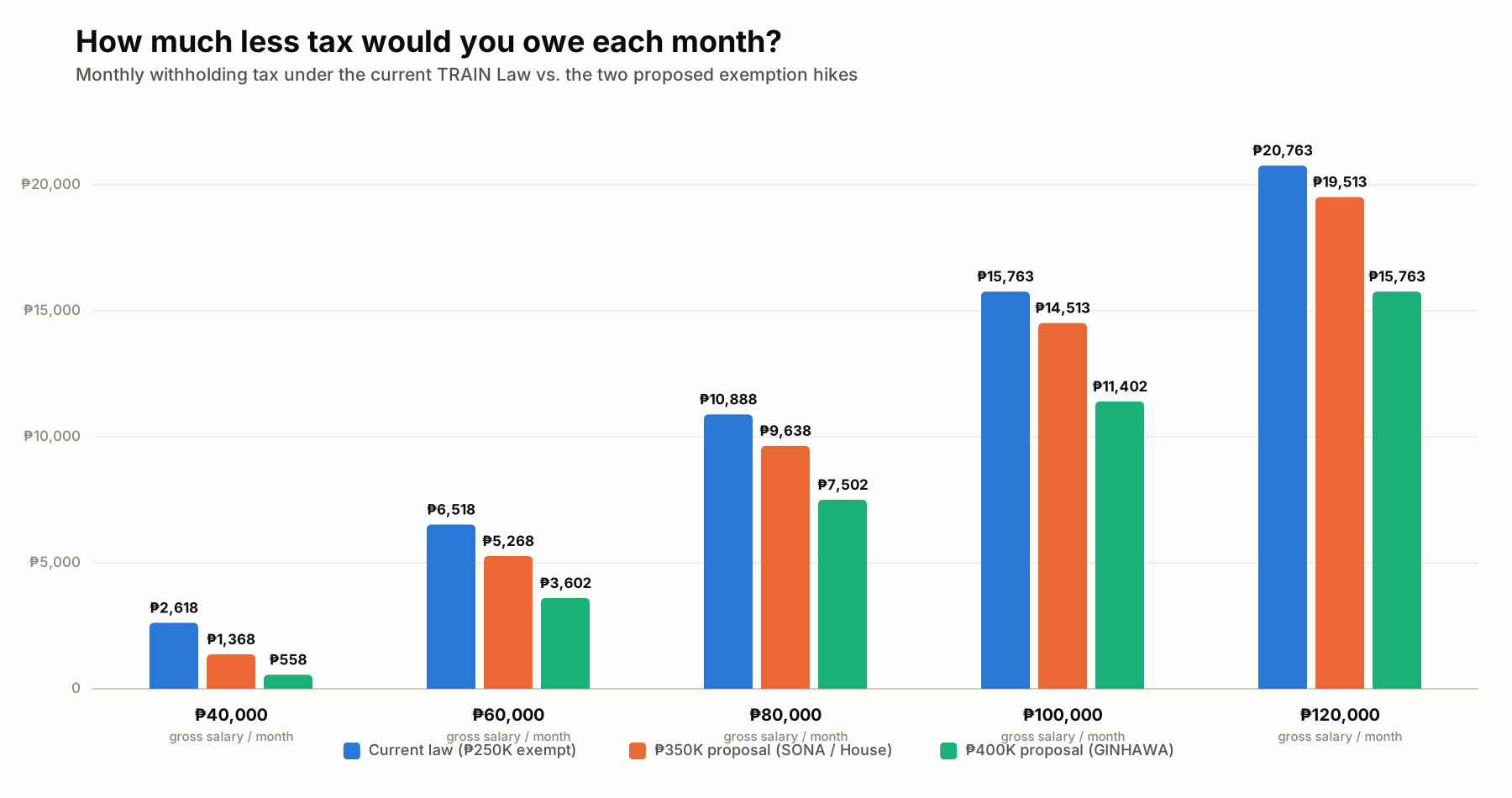
In his July 2026 SONA, President Marcos proposed raising the income tax-exempt threshold from ₱250,000 to ₱350,000 a year. A House panel has since advanced that version. Separately, the GINHAWA Act — Sen. Sherwin Gatchalian's Senate Bill 56, with matching House versions filed by Rep. Kenneth Gatchalian (HB 2616) and Rep. Jolo Revilla (HB 7952) — pushes for ₱400,000. Neither has been signed into law yet, but both are far enough along that it's worth actually running the numbers instead of just reacting to the headline figure.
Why ₱20,000 a month isn't the right place to start
Here's the thing most comparisons miss: under the current TRAIN Law, the first ₱250,000 of annual taxable income is already exempt. That's roughly ₱20,833 a month. Someone earning ₱20,000/month, after standard SSS, PhilHealth, and Pag-IBIG deductions, is already paying ₱0 in withholding tax today.
So a table that starts at ₱20,000 doesn't tell you anything about the reform — it's ₱0 under current law, ₱0 under the ₱350K proposal, and ₱0 under the ₱400K proposal. The comparison only gets interesting once you're past where today's exemption already tops out. That's why the numbers below start at ₱40,000/month, not ₱20,000.
The comparison: current law vs. both proposals
Figures are monthly withholding tax — gross salary minus SSS, PhilHealth, and Pag-IBIG, annualized, then run through each bracket structure. No bonuses or 13th month factored in, so this is your regular payday number, not a full-year picture.
| Gross salary / month | Current law | ₱350K proposal | ₱400K proposal (GINHAWA) | You'd keep (₱350K) | You'd keep (₱400K) |
|---|
| ₱40,000 | ₱2,618 | ₱1,368 | ₱558 | +₱1,250/mo | +₱2,061/mo |
| ₱60,000 | ₱6,518 | ₱5,268 | ₱3,602 | +₱1,250/mo | +₱2,917/mo |
| ₱80,000 | ₱10,888 | ₱9,638 | ₱7,502 | +₱1,250/mo | +₱3,386/mo |
| ₱100,000 | ₱15,763 | ₱14,513 | ₱11,402 | +₱1,250/mo | +₱4,361/mo |
| ₱120,000 | ₱20,763 | ₱19,513 | ₱15,763 | +₱1,250/mo | +₱5,000/mo |
Two very different mechanics are at work here:
The ₱350K proposal saves everyone the same flat amount. Whether you're at ₱40K or ₱120K, it saves exactly ₱1,250 a month — because this version only moves where the exemption starts. Everything above ₱400,000 a year is still taxed exactly like it is today (20%, 25%, 30%, 35%, unchanged), so the only thing that changes is the 15% bracket losing its bottom ₱100,000. That's a fixed-size gain: ₱100,000 × 15% = ₱15,000/year = ₱1,250/month, for anyone who clears the new exemption line.
GINHAWA doesn't just move the floor — it rescales every bracket by 1.6×. Per the actual bill text (House Bills 2616 and 7952), the whole schedule shifts: ₱400,000 exempt, then 15% up to ₱650,000, 20% up to ₱1,300,000, 25% up to ₱3,200,000, and so on — each threshold exactly 1.6 times today's. Because the brackets themselves get wider, not just the exempt floor, higher earners keep clearing tax at a lower rate for longer. The result: savings grow with income under this version — ₱1,250/month at the bottom of this table versus ₱5,000/month at the top, roughly quadruple.
Either way, the percentage relief is still front-loaded toward lower earners. At ₱40,000/month, GINHAWA cuts the tax bill by nearly 80%. At ₱120,000/month, it's about 24%. Even though the peso amount grows with income under GINHAWA, it grows more slowly than the tax bill itself does — so as a share of what you were already paying, the relief still favors people closer to the exemption line.
What if the threshold ends up higher than either bill — say, ₱40,000/month exempt?
Some advocacy groups have floated exempting minimum-wage-adjacent earners entirely, which would put the effective ceiling closer to ₱40,000/month (~₱480,000/year) rather than the ₱29K–₱33K/month the current bills work out to. Neither bill on the table today goes that far — but if one eventually did, the same logic from the ₱20,000 example above would apply one rung up: anyone at ₱40,000/month or below would owe ₱0 under that scenario, so the meaningful comparison would start at ₱60,000, not ₱40,000. The lesson holds regardless of which number the final law lands on — always compare from just above whatever the new exemption line is, not from whatever round number is easiest to type.
The assumptions behind these numbers
- ₱400K proposal (GINHAWA): taken directly from the bracket schedule written into House Bill 2616 (Rep. Kenneth Gatchalian) and House Bill 7952 (Rep. Jolo Revilla) — both filed versions use the identical schedule quoted above. This is the most solid number in this post.
- ₱350K proposal: no single reconciled bill text was checked directly for this post — the bracket structure above (floor moves to ₱350,000, ₱400K/₱800K/₱2M/₱8M breakpoints and their rates unchanged) reflects how the House-approved version has been consistently described in reporting on the measure. If the reconciled bicameral version rescales the whole schedule the way GINHAWA does instead of just shifting the floor, the ₱350K figures above would need to be revisited — the ₱400K ones would not, since those came from the bill itself.
Neither bill is law yet
As of this writing, both versions are still in Congress. The Income Tax Calculator on this site reflects current TRAIN Law rates — if either version gets signed, we'll update it and this post. Until then, treat every number here as "what if," not "what is."