Every Filipino professional hits this question eventually: keep renting, or start buying? Your titas will tell you renting is "throwing money away." Your finance-Twitter feed will tell you homeownership is a trap that ties up your capital for 20 years. Both are oversimplifying. Let's run the actual numbers.
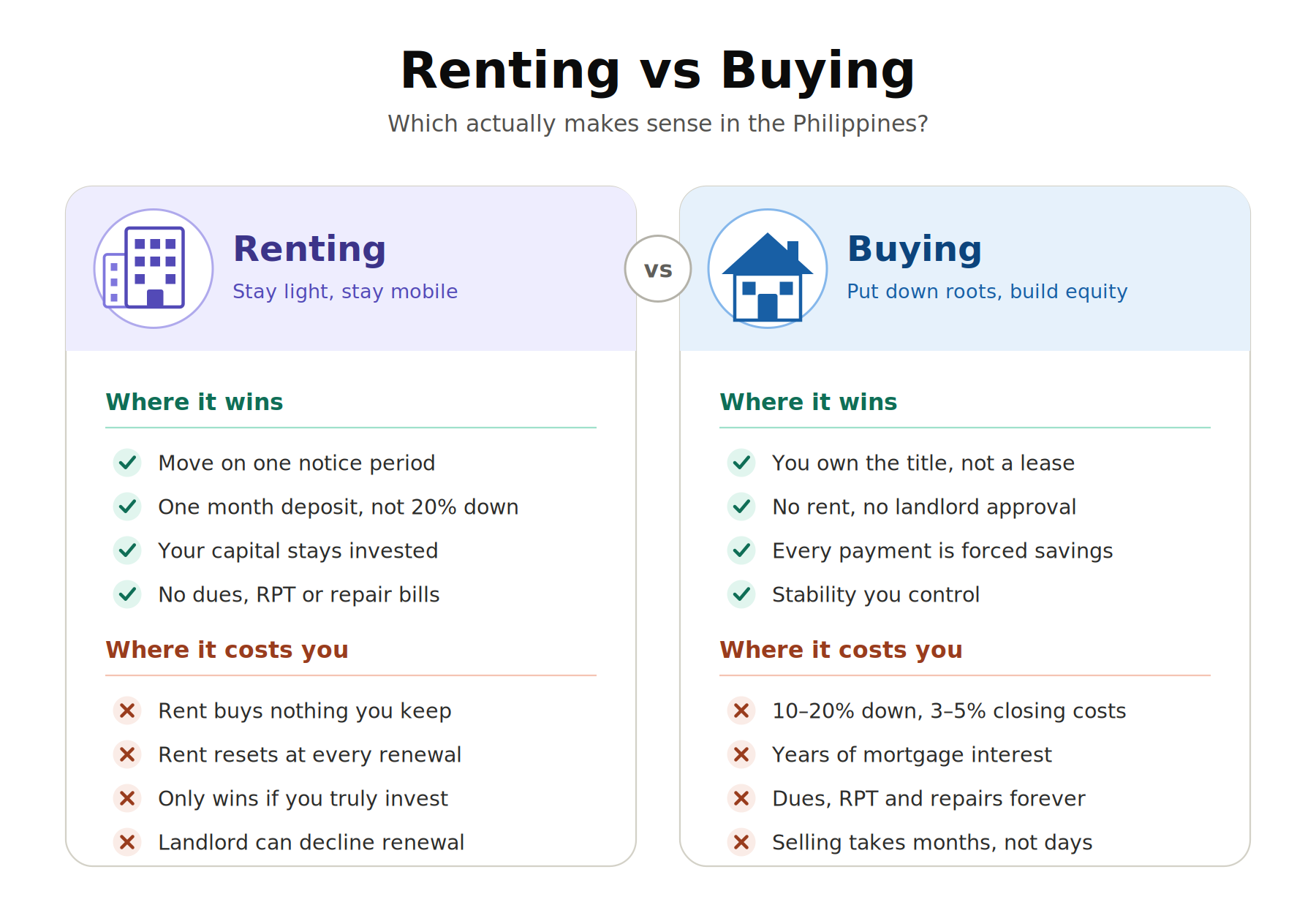
The Case for Buying
You're building equity, not paying someone else's mortgage. Every amortization payment splits into interest and principal — and unlike rent, the principal portion comes back to you as ownership. Stay in a ₱4M condo for 15 years and, barring a crash, you walk away with an asset, not a stack of receipts.
No rent increases, no landlord notice to vacate. Once you lock in a fixed-rate mortgage, your monthly housing cost is largely predictable for the life of the loan (property tax and association dues still creep up, but the big number — amortization — doesn't move). Renters in Metro Manila have watched unit rates climb 5–8% a year in in-demand areas; buyers are insulated from that.
Appreciation. Philippine real estate, especially in Metro Manila, Cebu, and Davao growth corridors, has historically appreciated 4–7% annually over long holding periods — though this varies wildly by location and isn't guaranteed. A unit bought for the "wrong reasons" (proximity to a new office, an upcoming train line) can still turn out fine on price alone.
The catch: the upfront cost is brutal. A typical bank loan requires 10–20% down. On a ₱4,000,000 condo, that's ₱400,000–₱800,000 in cash before you even talk about transfer tax, documentary stamp tax, registration fees, and agent's commission — commonly another 5–7% of the property price. Add loan interest (bank mortgage rates in the Philippines commonly run 6–8% per year, fixed for a few years at a time), monthly association dues, and real property tax, and "buying" is a lot more than the sticker price.
The Case for Renting
Flexibility. If your job could relocate you, if you're not sure which city you'll be in three years from now, or if you just don't want to be tied down — renting lets you move in 30 days with a forfeited deposit, not a property sale that can take months.
Lower upfront cost. Most Metro Manila leases ask for 1–2 months deposit plus 1 month advance. That's a fraction of a down payment, and it's cash you get back (minus damages) when you leave.
No maintenance burden. Busted aircon, leaking pipe, elevator out of service — that's the landlord's or the condo corporation's problem, not a surprise line item in your budget.
You can invest the difference. This is the part FIRE-minded renters actually calculate and homeowners often skip: if renting frees up ₱400,000+ that would've gone to a down payment, and that money goes into an index fund or MP2 instead, it compounds. At a conservative 7% annual return, ₱400,000 becomes roughly ₱787,000 in ten years — money a buyer doesn't have sitting in a fund, because it's locked into home equity instead.
The catch: you own nothing at the end. Every peso of rent is gone the moment you pay it. There's no equity, no asset to sell, and no protection against your landlord deciding not to renew.
Buy vs. Rent, Side by Side
| Buying | Renting |
|---|
| Upfront cost | 10–20% down + ~5–7% fees | 1–2 months deposit + 1 month advance |
| Monthly cost stability | Fixed amortization, rising taxes/dues | Rent can rise yearly |
| Who fixes what breaks | You (or the condo corp, for dues-covered items) | Landlord |
| Builds equity | Yes | No |
| Exit flexibility | Weeks to months to sell | 30-day notice, typical |
| Upside exposure | Property appreciation | Whatever you invest the difference into |
So How Do You Actually Decide?
Real estate investors lean on a simple screen: the price-to-rent ratio — divide the property's price by what a year of renting the same unit would cost. Take a ₱4,000,000 condo renting for ₱25,000/month (₱300,000/year): that's a ratio of about 13.3.
- Below 15 — buying usually wins over the long run; the math tilts toward ownership.
- 15 to 20 — it's close; other factors (how long you'll stay, your risk tolerance) should decide it.
- Above 20 — renting is typically the better deal; you're paying a steep premium to own.
The other number that matters more than people think: how long you'll actually stay. Closing costs and agent's commission alone can eat 7–10% of the property price — money you don't recover unless the property appreciates enough to cover it. As a rule of thumb, if you're not confident you'll stay put for at least 5 years, renting usually wins once you account for those upfront costs, even if the monthly math looks close.
A Quick Decision Checklist
Before you sign anything, be honest with yourself about:
- Timeline — Are you staying in this city/job for 5+ years? If not, lean rent.
- Cash reserve after the down payment — Buying shouldn't wipe out your emergency fund. If a ₱500,000 down payment leaves you with less than 3–6 months of expenses in reserve, that's a red flag, not a green light.
- What you'd do with the money otherwise — If "invest it" is a real plan you'll actually follow through on, renting-and-investing can beat buying on pure returns. If "invest it" really means "spend it," buying forces the discipline that a monthly amortization does.
- Rate environment — Mortgage rates move. Locking a fixed rate when they're relatively low changes the math meaningfully over a 15–20 year loan.
- Non-financial value — Stability for a family, control over renovations, not answering to a landlord — these don't show up in a spreadsheet, but they're real.
There's no universal right answer here. Buying wins if you're staying put, have the reserve to absorb the upfront cost without gutting your emergency fund, and value the forced equity-building. Renting wins if you value flexibility, want your capital working somewhere else, or simply aren't ready to commit to one address for the better part of a decade. Run your own numbers before you run either into a signature.
To your financial freedom, Mark